TL;DR
Overview
Background
A solo, 3-month project sparked by one question I couldn't shake: why does disagreeing online feel so bad?
Problem
Mainstream platforms reward engagement over nuance, burying alternative perspectives on topics that deserve real depth.
Approach
Over 3 months, I validated the problem through a competitive audit, a 29-person survey, and 3 interviews, then iterated through multiple rounds of concept testing.
Outcome
A mobile app with a 7-point opinion spectrum instead of a binary vote, built and tested with real users along the way.
87% TSR
Of 23 final testers completed the core "Hot Take of the Day" flow on their first try
Full
Interactive prototype with hover states and working buttons and pages
BACKGROUND
Older Gen Z loves discussing life online, but platforms reward engagement over nuance.
An early competitive audit found millions of posts about "how to live life" among Gen Z, from career talk to relationship advice. These platforms weren't built to hold that kind of conversation well.

PROBLEM
Mainstream platforms bury nuance in favor of what gets the most engagement.
That's a mismatch, heavy topics deserve depth, but these platforms are built for what's fleeting. My next step was figuring out exactly who I was designing for.
ACTIVE PAIN POINTS
People are already naming what's broken, I just needed to go find it.
Although these apps can produce thought-provoking discourse, I sifted through thousands of posts to find where healthy discourse actually breaks down.
Across thousands of unrelated discussions, the same frustration surfaced: like/dislike systems "control the narrative" and leave no room for nuance. That skepticism became the starting point for Groundid.
COMPETITIVE AUDIT
Even platforms built for discourse still leave something out.
I audited Substack, Medium, Quora, X, and Reddit for how they support real discourse. Each did something well, but none fully solved for nuance, credibility, and community together.

USER SURVEY
I needed to hear directly from the people living this problem.
I surveyed 29 "perspective seekers" active on X, Substack, and Reddit to understand how they experience discourse online today.
TOTAL SURVEYED
29 "perspective seekers"
Who appreciate engaging with life discourse online (including new grads, full-time workers, college students, and job-seekers) across X, Substack, and Reddit
"LIKE/DISLIKES" AREN'T THE FULL PICTURE
76% (22)
Express "rarely" or "never" on how often a "like/dislike" captures their full stance when reacting to content relating to life choices (e.g career shifts, relationship dynamics)
DO YOU REFERENCE YOUR LIVED EXPERIENCE
83% (24)
Express they are "somewhat likely" to "highly likely" to reference their lived experience in their comment. (2 mentioned they haven't commented publicly)
HOW VALUED THEIR PERSPECTIVE FEELS
52% (15)
Expressed their perspectives feel "not valued," "minimally valued" or "neutral" by the app's system.
USER INTERVIEWS
Three conversations to understand what keeps people coming back, and what pushes them away.
I interviewed 3 perspective seekers one-on-one on Zoom to go deeper on what keeps them engaged, and what pushes them away.
Takeaways: What "perspective seekers" value.

"Perspective seekers" want different perspectives surfaced
They fear engagement-over-credibility systems are burying alternate viewpoints.


They want to feel like nuance is valued in conversations
Especially within serious topics where nuance is required to have fruitful dialogue.

They are highly intrigued by others' lived experiences
On making important life decisions, often relying on digital outlets for info outside their bubble.
DESIGN APPROACH
All that research had to become actionable steps I could design for.
First, I began outlining the project intent. I iterated until I came up with a statement that encompassed potential solutions to pain points expressed in the surveys and interviews.
🌱
Goal #1
Ship a minimum viable product that proves the core concept before expanding further.
🎯
Goal #2
Satisfy people's craving to engage in healthy fruitful discourse and access life-related content.
Non-Goal #1
Not solving full content moderation and trust and safety infrastructure in this phase.
🚧
Non-Goal #2
Not re-creating short-form social media.
🚫
IDEATION
Getting every idea out before judging any of them.
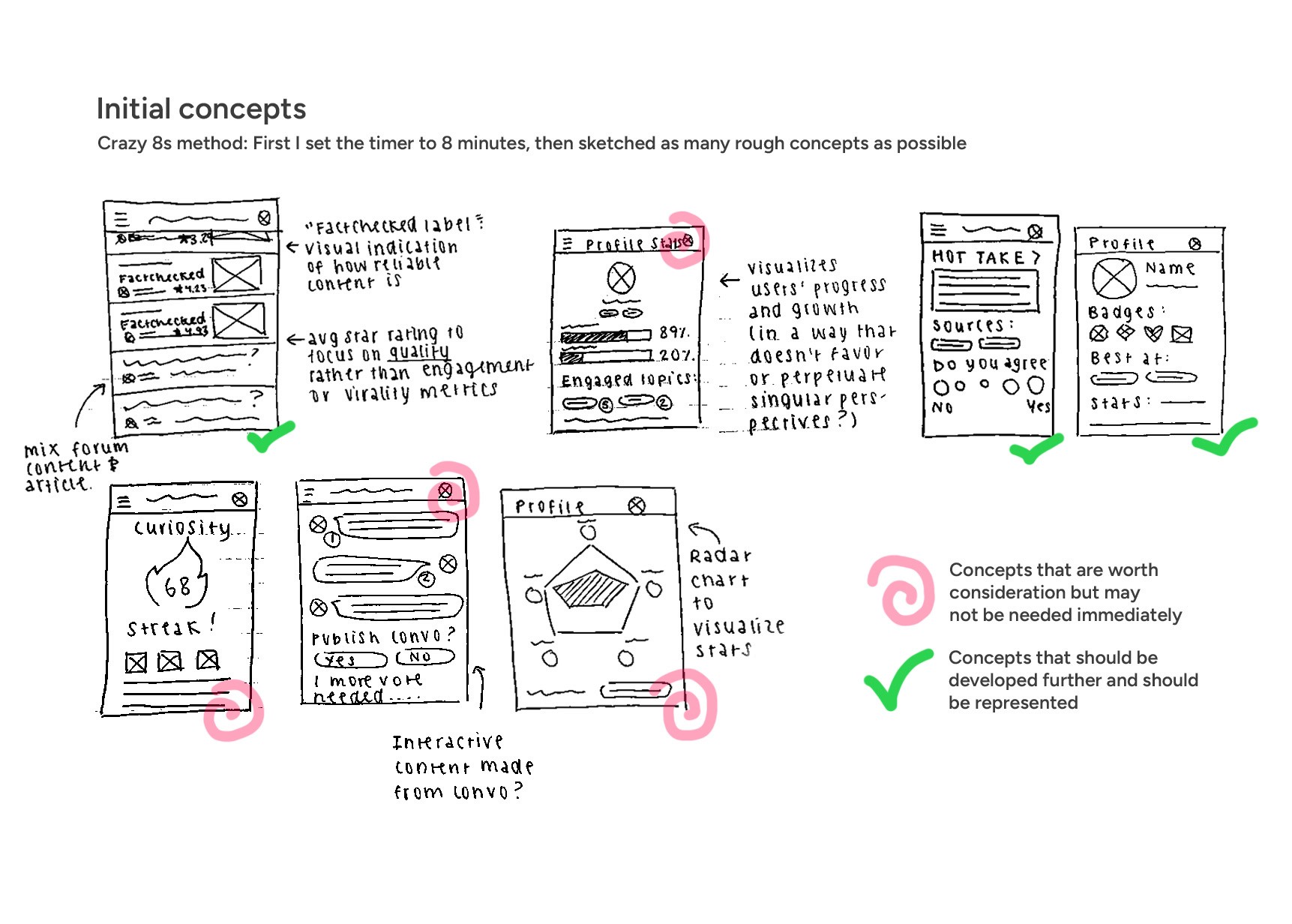
I drafted concepts on paper using the Crazy 8s method to explore as many directions as possible before narrowing in.
TESTING
Real feedback, not assumptions, shaped what came next.
I tested early concepts with users, recorded their reactions, then sorted the feedback into pain points and successes.

One tension from that feedback stuck with me more than the rest.
What Didn't Work
After gathering feedback from usability testing, it was conflicting with research gathered from interviews, but not because any of their experiences were invalid.
😄
Observation #1
Testers actually favored a familiar upvote/downvote model because it worked the way other popular apps do (hi, Jakob's Law).
But the more I sat with that feedback, the more the conflict bothered me:
Observation #2
A binary vote was doing exactly what perspective seekers said they hated, flattening a nuanced stance into a yes/no.
🫤
So I traded familiarity for honesty and built the 7-point opinion spectrum instead, an intentional harder interaction to learn at first glance, and one I'd still like to make feel more effortless. That's part of my Next Steps list.
FINAL DESIGN
What survived the research, the testing, and the rewrites.
After multiple rounds of design and testing, here's the fully interactive prototype for Groundid!
Key Final Screens


Features Spotlight
A look at the real features along with the design rationale.


Hot Take of the Day
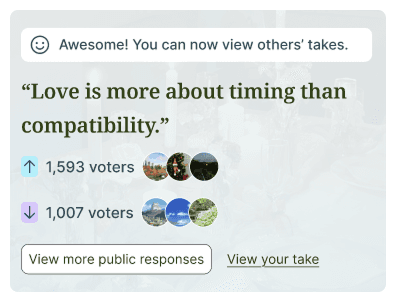
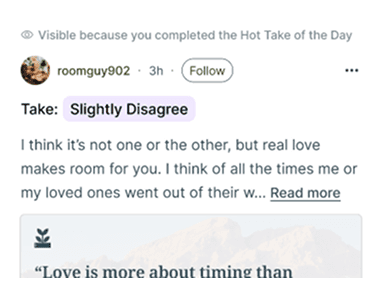
A 7-point spectrum instead of a binary vote, since 76% of testers said like or dislike never captured how they really felt.
Long-Form Articles
No character limit for advice that needs more room than a caption, since 83% of respondents said they draw on lived experience.


Profile Stats
A quick look at someone's posting history, so you can gauge their credibility, since testers wanted proof a take was worth trusting.


Cited References
Authors are encouraged to cite sources, since my audit showed people trust credible, crowdsourced opinions over whoever just sounds most confident.
Meet New People
Warm, low-pressure conversation starters, since interviews showed people are genuinely curious about experiences outside their own bubble.
INTERACTIVE PROTOTYPE
Try it yourself!
Walk through the "Hot Take of the Day" flow, the same one 87% of testers completed on their first try.
Full Prototype
REACTIONS
From Testers

NEXT STEPS