TL;DR
Overview
Background
An 8-week project, reopening a stalled notifications project for WEX's Corporate Payments team to overhaul legacy model.
Problem
Finance workers lost time jumping across 2+ tabs just to act on a single alert.
Approach
Of a 4-person team, I led research synthesis and journey mapping, then proposed the Inbox direction the team ultimately built.
Outcome
A unified Inbox system that boosted task success rate by 11.8% over the legacy model.
2 → 1
Notification tabs consolidated into a single Inbox

BACKGROUND
Business customers relied on WEX's alerts for time-sensitive activity, but the system wasn't built for speed.
These alerts are the primary way WEX communicates critical account activity to Corporate Payments clients, but the existing system buried timely information across a fragmented, multi-tab experience.

PROBLEM
Finance workers couldn't act on alerts quickly enough.
Every alert sent them hunting across 2+ tabs for the right record, creating delays exactly when speed mattered most.
RESEARCH
The research already existed, I just needed to turn it into direction.
I synthesized existing interviews and data to surface improvement opportunities, unseen pain points, and a clearer picture of our finance teams.
USER DATA
Users wanted to immediately take action and maintain a usable record of older alerts.
Using Dovetail, UserTesting, and existing interviews, I found users struggled to search past alerts, keep records, and take timely action.

USER JOURNEY MAP
While resolving a payment issue, users found locating the affected record to be frustrating and overwhelming
I mapped the user journey to find where the process broke down: filtering and viewing specific records in full context to inform decision-making. Full map withheld for confidentiality.
COMPETITIVE ANALYSIS
Fintech competitors prioritized immediate actionability and strong record-keeping
I signed up for demos across leading fintech platforms to see firsthand how competitors handled alerts. Full audit withheld for confidentiality.
KEY INSIGHTS
Two patterns kept surfacing: what frustrated users, and what they actually needed.
😕
Observation #1
Finance controllers checked email for alerts, but had to log into WEX just to investigate.
Observation #2
Users wanted one place to review, act on, and revisit every alert.
🌟
DESIGN FOCUS
User needs, business goals, and technical constraints all had to point the same direction.
Drawing on research and conversations with PMs and stakeholders, I mapped priorities across all three, giving the team a shared reference for every design decision going forward. That left one clear question: how might we move from alert to action more clearly and efficiently?


WIREFRAMES
I explored multiple directions before committing to a single one too soon.
In a 10-minute timed sprint, I sketched side-panels, popovers, an inbox, and toast notifications, then gathered feedback on each before narrowing in.
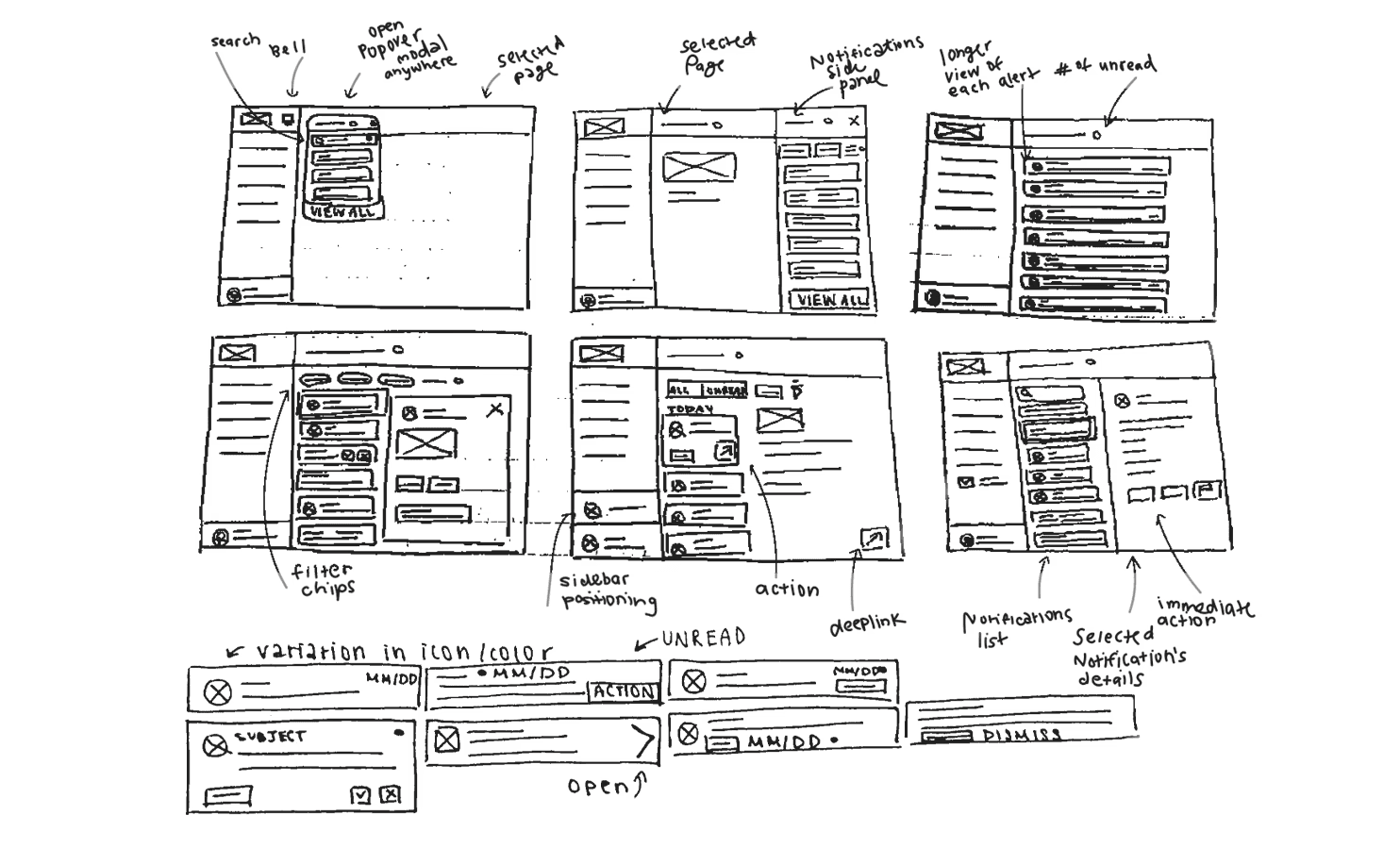
One early signal stood out: Inbox tapped into Jakob's Law, the comfort of a pattern users already trusted. It wouldn't be the only point of discussion I'd need.
MID-FI PROTOTYPES
Both directions made it to testing, Inbox and Popover, still neck and neck.
I built out mid-fi prototypes for both, so the team could test real interactions, not just static concepts, before stakeholders had to choose.

Stakeholders initially favored a bell-modal popover. I proposed we prioritize Inbox instead, and presented research showing users needed full context before acting, not just a glance, which shifted the team. An early round of testing confirmed the direction, and Inbox moved forward for formal usability testing.
TESTING
The Inbox design held up under real use, boosting task success by 11.8% over the legacy system.
I ran usability tests with 12 internal users, comparing the new Inbox flow against the legacy alert system on resolving a flagged alert. Underlying test data withheld for confidentiality.

UX COPYWRITING
Ambiguity causes anxiety in finance, so I made sure every alert had a clear resolution.
I owned the microcopy for every alert type, applying a severity + cause + action structure and the 12-Year-Old Rule to keep urgency and next steps unmistakably clear. Once the structure held, I used Gemini, made available through WEX's AI partnership, to refine both phrasing and ideas across variants, while the framework and reasoning stayed mine.
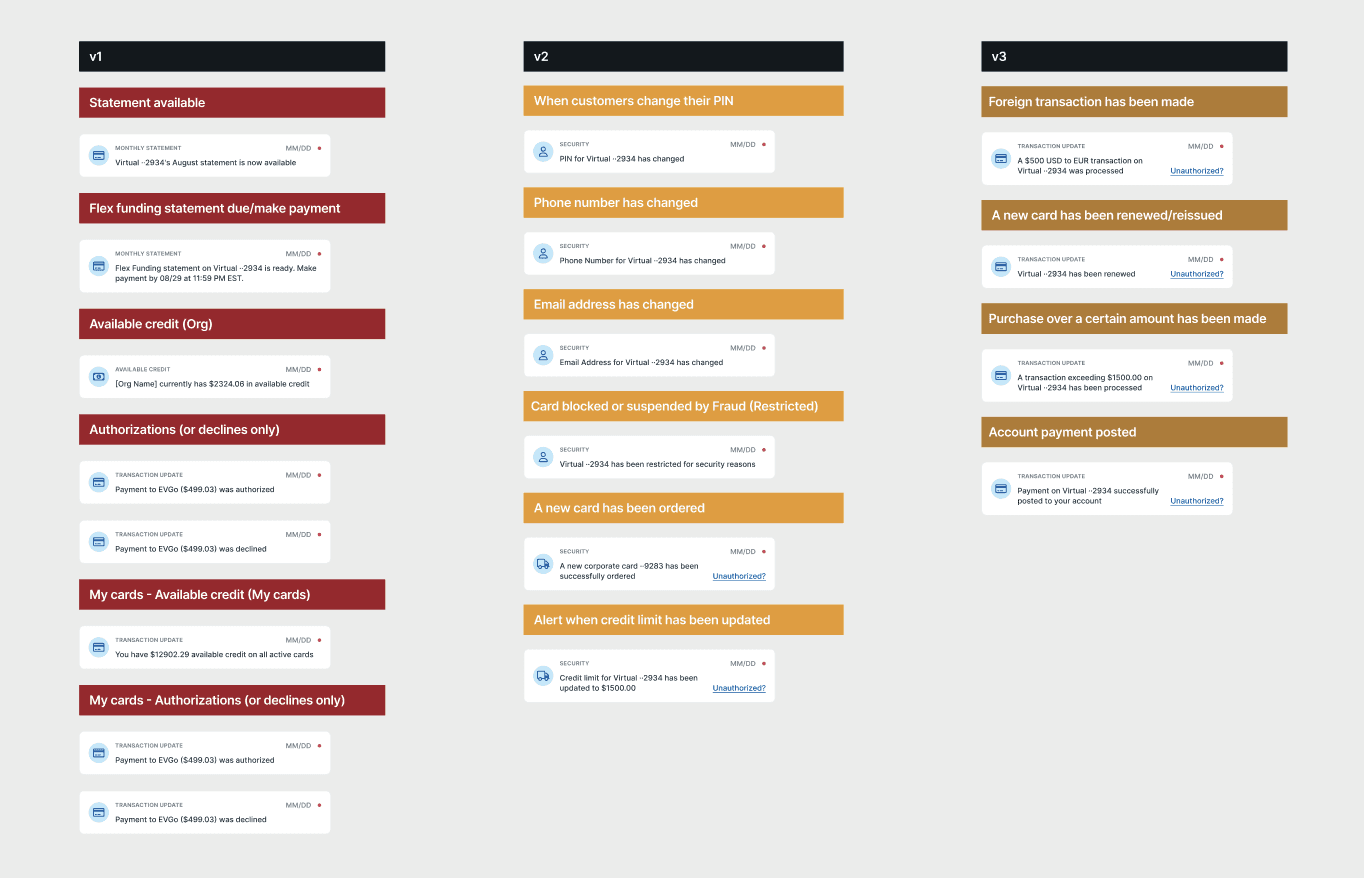
These three versions reflect a stakeholder-driven split, with the severity + cause + action framework applied consistently throughout.
Contribution Highlights

Component Craft
Within WEX's design system, I built a component with text, boolean, and icon-swap properties, synced by variables, with flexbox logic documented for handoff.

UX Copywriting
I owned the microcopy for every alert, using a severity + cause + action framework.
Research Synthesis
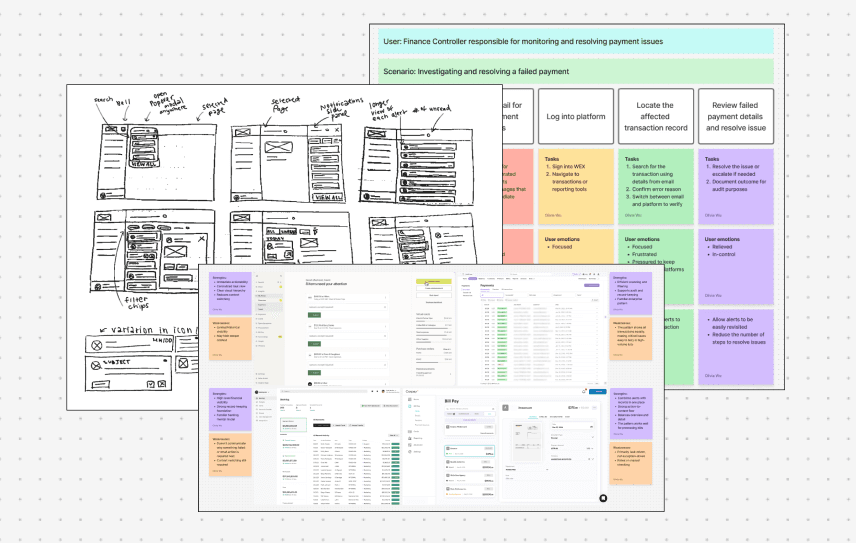
I synthesized prior research into clear pain points, then mapped the user journey to find where things broke down.

Stakeholder Buy-In
I proposed Inbox over stakeholders' preferred popover, then won them over with research.


NEXT STEPS
Inbox proved the concept. Here's what's left before it's done.
Notifications ran alongside other WEX projects, our B2B microsite and investor data viz work, so 8 weeks meant real progress, not a finished product.
Test beyond the one validated task
The 12-user study proved Inbox works for resolving a flagged alert. I'd want to test edge cases next, urgent multi-step issues, and workflows for underrepresented client types, not just the core happy path.
Push type-distinction past copy and icons
Alerts are currently told apart by copy and severity iconography. Since the component already supports color swapping, I'd explore whether color or layout variation could make type distinguishable at a glance, without reading a word.
COLLABORATIVE CREDITS
The team behind this feature
PRODUCT DESIGNERS
Chris Dilios
Adam Cassidy
Nick Zimmerman
Olivia Wu
RESEARCH
Lucas Montandon
Jeet Purohit
PRODUCT MANAGEMENT
Paola Aguayo
Rebecca Clark
A LITTLE NOTE FROM ME!